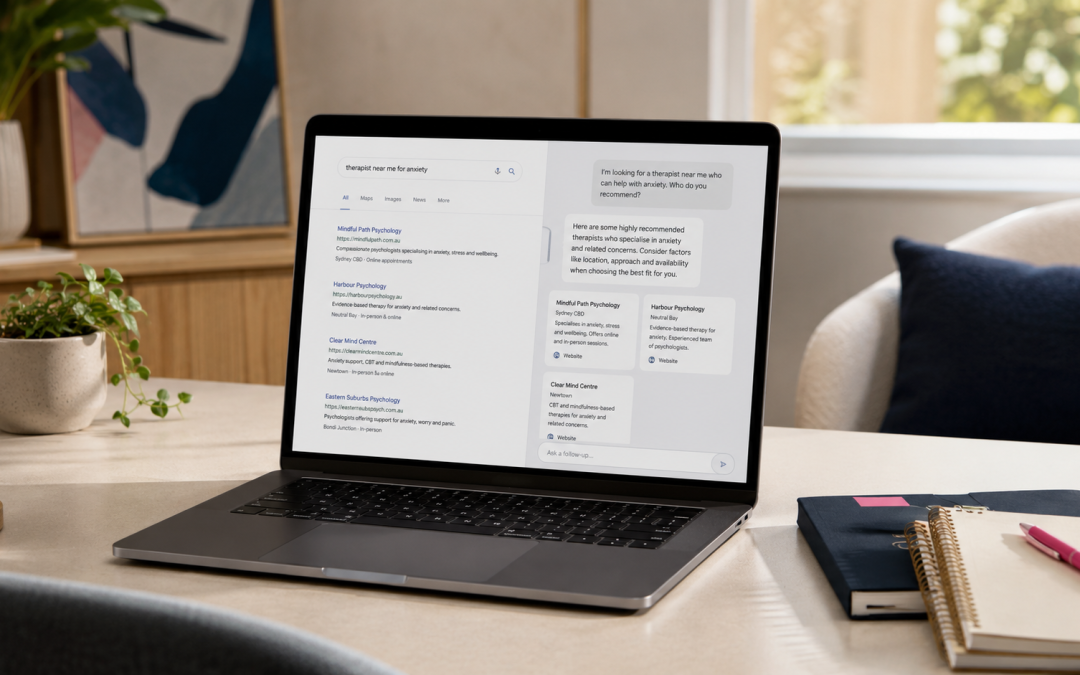
Quick answer: Google Search and AI search are not two completely separate marketing channels. SEO is still the foundation. Your website needs to be crawlable, useful, clearly structured and relevant to the searches your audience makes. AI search adds another layer: your services, practitioners, locations and answers also need to be clear enough for answer engines to understand and potentially reference. For most mental health and allied health practices, the right approach is SEO and AEO working together.
If your practice website was built with Google in mind, that’s still important.
But it’s no longer the whole picture.
People looking for mental health and allied health services can now move between traditional Google results, map listings, AI-generated search results and conversational tools when they’re trying to find information.
They might search:
psychologist near me
They might ask:
Who provides adult ADHD assessments near Brisbane?
Or:
Which occupational therapy practices offer telehealth appointments?
Those are different types of searches, but your website needs to give search technology enough clear information to understand the answer to all of them.
That does not mean SEO is dead.
It means good SEO now has to work alongside clear, useful, well-structured content that can also be understood by AI-powered search.
Google Search vs AI search: what’s the difference?
At a simple level, the difference is how someone asks for information and how that information is presented back to them.
| Google Search | AI-powered search | |
|---|---|---|
| What someone does | Types a search query | Often asks a full or conversational question |
| What they may see | Search results, maps, websites, ads and other search features | A generated answer that may include supporting sources and links |
| What matters | Relevance, useful content, technical SEO, local signals and authority | Clear information, strong underlying SEO, context, useful answers and reliable source information |
| How your website helps | Gives Google a relevant page to rank and people a reason to click | Gives answer engines clear information they can understand and potentially reference |
| The goal | Be visible for relevant searches | Be understandable and useful when AI systems retrieve information about the topic |
The important part is this:
You do not optimise for one and ignore the other.
The foundations overlap.
Is SEO still important when people are using AI search?
Yes.
SEO is still the foundation of being found online.
Your website needs to be technically accessible, properly indexed and structured so search engines can understand what each page is about.
For a mental health or allied health practice, that usually means getting the basics right first:
- clear service pages
- accurate page titles and headings
- a useful homepage
- strong internal links
- clear practitioner information
- accurate location information
- a properly maintained Google Business Profile
- mobile-friendly pages
- useful written content
- sensible website structure
- pages that search engines can actually crawl and index
If those foundations are weak, adding the words “AI” or “AEO” to your marketing plan isn’t going to fix the underlying problem.
So where does AEO fit?
AEO stands for Answer Engine Optimisation.
It’s the part of search optimisation focused on making your information clear and useful when people search by asking questions rather than only typing traditional keywords.
AEO does not mean trying to trick an AI tool into mentioning your practice.
It also isn’t one magic piece of code that suddenly makes a website “AI optimised”.
Good AEO is much more practical.
It means making important information easy to find and easy to understand.
That can include:
- answering common questions directly
- using descriptive headings
- keeping sections focused
- clearly explaining each service
- stating who a service is for
- making locations and service areas obvious
- explaining whether telehealth is available
- clearly identifying practitioners and their roles
- keeping practice details consistent
- using tables where a comparison is genuinely useful
- keeping important information in visible website text
- publishing useful content around the questions people actually ask
That structure helps real people too.
Which is exactly the point.
Want the deeper explanation?
We’ve also put together a dedicated guide to AEO and SEO for mental health and allied health practices.
Can a practice rank on Google but still be difficult for AI search to understand?
Yes.
A website can contain all the right general information but still be vague about the things someone actually needs to know.
For example, a service page might say:
“We provide personalised, compassionate support tailored to your needs.”
It sounds polished.
But what does it actually tell a search engine or someone comparing practices?
Not much.
A clearer page would make the practical information obvious:
- What is the service?
- Who provides it?
- Who is it intended for?
- Where is it available?
- Is telehealth available?
- How does someone enquire?
- Is a referral required?
- What funding or billing information is relevant?
- What questions do people normally ask before booking?
Clear information gives people more confidence in what they’re looking at.
It also gives search systems more context about what the page actually represents.
Why vague practice websites create problems
A lot of health practice websites were originally written to sound warm and professional.
That matters.
But warmth without clarity can create a website where every page starts to sound the same.
“Individualised care.”
“Supporting your journey.”
“Helping you thrive.”
“Compassionate support.”
None of those phrases clearly tell a person, Google or an AI-powered search system what service is actually available.
A strong website can still sound human while being specific.
That means saying what you do in plain English.
What should mental health and allied health practices optimise first?
You do not need to rebuild an entire website overnight.
Start with the pages closest to enquiries and referrals.
1. Your homepage
Someone should be able to quickly understand:
- what type of practice you are
- the main services you provide
- where you work
- whether you offer telehealth
- who your services are for
- what the next step is
Do not make visitors hunt through the site to work out what the practice actually does.
2. Your major service pages
Each important service should have enough useful information to stand on its own.
Avoid squeezing ten different services into one short page.
Where a service matters commercially, give it a clear page that explains it properly.
3. Practitioner information
Make practitioner roles and areas of work clear.
A list of qualifications on its own may not answer the questions someone researching the practice actually has.
The page should make it easy to understand who the practitioner is, their professional role and which services they provide, without making unsupported clinical outcome claims.
4. Your location and service-area information
If you work locally, make the location clear.
If you work nationally through telehealth, say that clearly too.
Do not make search engines piece together your geography from a phone number and footer address.
5. Google Business Profile
Your website and Google Business Profile should tell the same story.
Keep the important details accurate and current, including:
- practice name
- address
- phone
- website
- opening information
- service categories
- relevant business information
Consistency matters.
6. Questions people actually ask
Some of the most useful content comes directly from real questions.
What do people ask before booking?
What do referrers ask?
What causes confusion?
What are practice owners constantly explaining on the phone?
Those questions can become:
- service-page sections
- blog posts
- short direct-answer sections
- useful FAQs
- email content
- social content
That gives your marketing a reason to exist beyond simply “posting more”.
Should every page have FAQs?
No.
Add questions where they genuinely improve the page.
A good FAQ-style section can be useful when there are clear questions people regularly ask.
A forced list of generic questions added to every page for “SEO” is not useful.
The goal is not to manufacture more content.
The goal is to answer the questions that matter.
Do you need special AI schema to appear in AI search?
Not as a magic shortcut.
Structured data can still help search engines understand certain types of content, but there is no single piece of “AI schema” that guarantees a practice will appear in an AI-generated answer.
The visible content still matters.
Your website has to clearly communicate what the practice is, what it does and why a particular page is useful.
That is why we treat AEO as part of the wider website and search strategy rather than a technical add-on.
What about Article schema?
For useful blog content like this, standard BlogPosting/Article structured data can help search engines understand information such as:
- the article title
- author
- publication date
- updated date
- featured image
That is different from claiming the schema itself will make the article appear in AI search.
It won’t.
The content still has to be good.
Should you add FAQ schema?
For this article, no.
Keep the FAQ-style questions visible in the article because they make the page useful and easy to navigate.
Do not add separate FAQ structured data just for SEO.
What makes content easier for AI-powered search to use?
There is no guaranteed formula, but there are sensible principles.
Be specific
Generic information is easy to replace.
Specific information about your services, location, processes and expertise gives the page a clearer purpose.
Answer the question early
Do not make someone read 800 words before receiving the basic answer.
That is why this article started with a direct answer.
Use descriptive headings
A heading like:
Do you need special AI schema to appear in AI search?
is much more useful than:
The next step
People can scan it.
Search systems can understand it.
Use tables when they actually help
The Google Search vs AI search comparison near the beginning of this article is information that genuinely makes more sense side-by-side.
That is a good reason to use a table.
Keep important information as text
If the only explanation of your service is inside a graphic, infographic or image, you are making the page harder to understand.
Images should support the content, not replace it.
Keep information current
Old practitioner information, outdated services, old addresses and inaccurate funding information create confusion for people and machines.
If something changes, update the page.
Support what you say
Avoid sweeping claims.
If you say your practice provides something, the website should contain enough information to support and explain that statement.
For regulated health businesses, clarity also needs to sit alongside appropriate advertising compliance.
AHPRA advertising matters here too
SEO and AEO do not sit outside your normal advertising obligations.
More visibility does not mean more freedom to make clinical outcome claims or use inappropriate advertising language.
The goal is to make your practice easier to understand, not to make claims you would not otherwise publish.
Can anyone guarantee your practice will appear in an AI answer?
No.
AI-generated answers change.
Search results change.
The sources used for one question can differ from the sources used for another.
No legitimate marketing provider can guarantee that a particular AI tool will recommend a particular practice for a particular question.
What you can do is improve the underlying signals:
- make the website technically sound
- create genuinely useful content
- clearly explain services
- maintain accurate business information
- build useful internal connections between related pages
- strengthen search visibility
- keep important information current
- make your website easy for people and search systems to understand
That is a much more useful strategy than chasing a guaranteed “AI ranking”.
So should your practice focus on Google or AI?
Both.
But not by creating two completely separate marketing strategies.
Think of it as one search ecosystem.
Traditional SEO helps build the technical and content foundation.
AEO makes sure the information on top of that foundation is clear, specific and easy to answer from.
Your website, service pages, Google Business Profile, practitioner information and educational content should all support the same picture of your practice.
When those pieces agree with each other, your marketing becomes much easier for people to navigate and search systems to understand.
Where does content fit?
Content should support the services your practice actually wants people to find.
For example, instead of publishing another generic article about “five tips for wellbeing”, a practice may be better served by publishing useful information that answers a real question connected to one of its services.
That creates a clear relationship:
Service page → useful supporting article → related question → clear next step
This is also why comparison articles can work so well.
People search them because they are trying to make a decision.
The content has a real purpose.
How we approach SEO and AI visibility at Time Well Spent
At Time Well Spent, we do not treat AEO as a separate gimmick added onto a website.
We look at how the whole marketing system works together:
- website structure
- service pages
- SEO
- AEO
- Google visibility
- Google Business Profile
- content
- email marketing
- lead pathways
- conversion tracking
- reporting
We use these principles on our own marketing as well as the work we do with mental health and allied health practices.
That matters because visibility on its own is not the goal.
A website should also make it easy for the right person to understand the practice and know what to do next.
Want to know how findable your practice actually is?
If your practice is relying on a website that was built years ago, occasional social posts and traditional SEO alone, it may be worth looking at how the whole system is working now.
We help mental health and allied health practices improve the way their website, SEO, AI visibility, content and lead pathways work together.
You can see exactly what that includes here:
No hard sell.
If it looks like there are worthwhile opportunities, we’ll show you what we’d prioritise.
If not, we’ll tell you that too.
Frequently asked questions
What is AI search?
AI search refers to search and answer experiences that use generative AI to help respond to a person’s question. Instead of only displaying a traditional list of links, an AI-powered search experience may generate a direct response and provide supporting sources or links.
What is AEO?
AEO stands for Answer Engine Optimisation. It focuses on making website information clear, structured and useful for question-based and AI-powered search experiences while working alongside traditional SEO.
Is AEO replacing SEO?
No. SEO remains the foundation. AEO works alongside it by making important information easier to understand and answer from.
Do mental health and allied health practices still need SEO?
Yes. Search engines still need to crawl, understand and index website content, and people still use traditional search, local results and Google Business Profile when looking for services.
Can AEO guarantee that ChatGPT or another AI tool recommends my practice?
No. No provider can guarantee inclusion in a specific AI-generated answer. AEO is about strengthening the clarity, usefulness and technical foundations that can improve how easily information about a practice can be understood.
Do I need special AI schema?
There is no single special AI schema that guarantees inclusion in AI-powered search. Use appropriate standard structured data where relevant and make sure it accurately represents the visible content on the page.
What should a practice optimise first?
Start with the homepage, major service pages, practitioner information, location details, Google Business Profile and the questions people regularly ask before making an enquiry or referral.